What a Residential Painting Company Does, Start to Finish
A residential painting company sells you a process, and the process is what you're paying for. The difference shows up in six places: a measured, written estimate; a crew with a lead you can reach; protection and prep that are planned rather than improvised; paint matched to the desert; a final walk you do together; and someone who still answers the phone when the warranty matters. If a painter can't describe all six, you're hiring an individual, and that's fine for some jobs. Here's how to tell which one you need.
If you've searched for a residential painting company in Las Vegas, Reno or Southern Utah, you've probably noticed that the results are a mix. Some are companies with crews, trucks and an office. Some are one person with a van and a great reputation on Nextdoor. The estimates can look similar, and the finished walls can look similar on day one. The difference is in everything that happens between the first call and the day you cash in on the warranty, which is the part nobody shows you on their website.
This guide walks through what a residential painting company actually does on your home, stage by stage, so you know what you're paying for and what to expect. If you want a checklist for comparing bidders, our guide on how to choose a house painter in Las Vegas covers that. This article is about what the company you pick should actually do, from the first visit to the warranty call.
Stage one: the estimate visit is a measurement, not a guess
A company estimate starts with someone walking your home and measuring it. Not eyeballing it from the curb, measuring it: wall lengths, ceiling heights, the square footage of stucco, the number of doors and window frames, and the condition of every surface that's going to get paint. The number you get at the end is built from those measurements and the labor they imply.
What you should receive is a written scope, line by line. Which rooms or elevations (an elevation is one face of the exterior, like "the north side"). Which surfaces in each one. What preparation is included on each surface. Which products, by name. How many coats. What's excluded. A company does this partly for you and partly for itself, because the crew that shows up to paint is usually not the person who wrote the bid, and the crew needs instructions it can follow.
A good estimator also asks questions a solo painter often skips: Is the house in an HOA, and has the color been approved? Are there repairs hiding under the paint, like hairline stucco cracks or water-stained drywall, that need fixing first? Is anyone in the house sensitive to fumes? When do you need it done by? Those answers change the scope, and a company would rather change it on paper than on your driveway.
One honest note on price: if the written scope is thin, the price means very little, because you can't tell what it buys. Two bids that differ by a few hundred dollars might differ by a full coat of paint or by whether anyone is going to wash the exterior first. If you want to understand what moves a painting price in this market, our Las Vegas house painting cost guide breaks it down.
Stage two: scheduling, and why a crew changes the math
A single painter working alone paints a typical three-bedroom interior in a week or more, and a full exterior repaint can stretch across two. That isn't a criticism of the painter, it's simple arithmetic. A residential painting company sends a crew with a crew lead, and the same job happens in days rather than weeks. For an exterior in July in Henderson or St. George, that matters, because the window for applying paint before the stucco gets too hot to work shrinks to the morning hours.
The other scheduling difference is capacity. If a solo painter gets sick, breaks a wrist or has a job before yours run long, your start date moves and there's no one to absorb it. A company has other crews. Your job might still shift, but it shifts by a day, not a month.
You should get a start date in writing, an expected number of working days, and the name of the person who will be on site running the job. Ask for that last one specifically. "Who is my crew lead, and how do I reach them?" is the most useful question you can ask before anyone opens a paint can.
Stage three: who is actually in your house
This is the question homeowners care about most and ask least. A company should be able to tell you, plainly, how it vets the people it sends to your home. At AllPro, every crew we send is background checked and badged, and the crews we work with have worked with us for five years and longer. Customers name the same AllPro people in their reviews year after year, going back to 2016, which is a better proof of consistency than anything we could say ourselves.
A company also carries the paperwork that protects you if something goes wrong. In Nevada, that means a current contractor license you can look up with the State Contractors Board, a license bond, and insurance that covers both damage to your property and injury to someone working on it. In Utah, the Division of Professional Licensing (DOPL) runs the same kind of lookup. AllPro holds Nevada license #76639 and Utah license #10696814-5501, is bonded and insured, and carries a residential improvement bond as well. If a painter can't give you a license number in writing, that's your answer about whether they're a company.
If you manage a commercial building rather than a home, the verification checks are stricter and the stakes are different. Our guide on vetting a commercial painting contractor in Nevada covers license classifications, bid limits and certificates of insurance, and our commercial painting team handles that side of the business.
Want to see what a measured, written estimate looks like on your own home? AllPro Painters was founded in 2008, has completed 10,000+ projects, and backs every residential job with a 5-year warranty. We serve Las Vegas, Reno and Southern Utah. No pressure, and we respond within 2 hours during business hours.
Reserve a free estimateStage four: protection and prep are planned, not improvised
Every painter will tell you prep is most of the job. The difference with a company is that prep is written into the estimate and assigned to specific people, so it happens the same way on every job rather than depending on how the day is going.
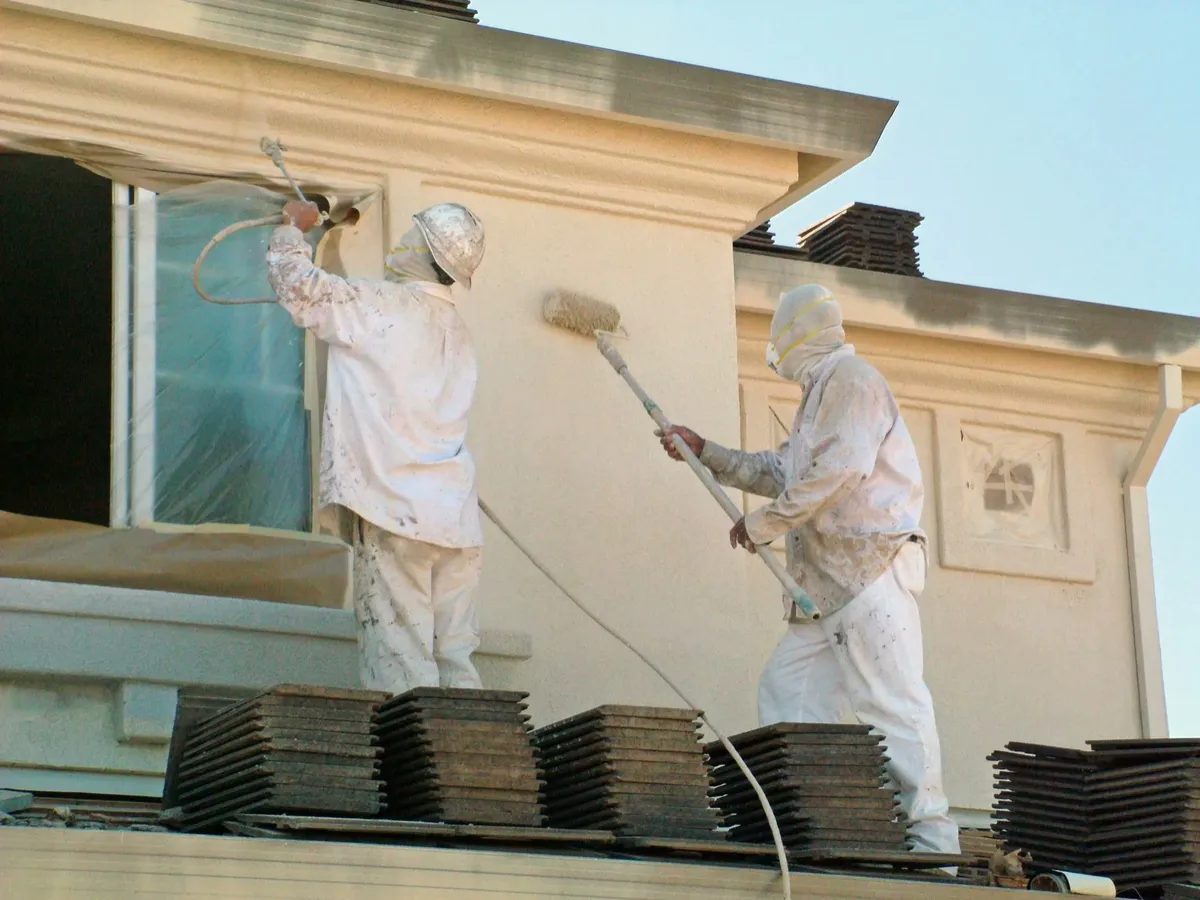
On the first morning, before any paint is opened, the crew covers what isn't being painted: floors, furniture, countertops, light fixtures, and outside, the plants, pavers and patio.
Then the prep itself, which is different for stucco, drywall and trim, and which is why it belongs in writing: your estimate should say what gets done on each surface before any color goes on, so you can check it against what you see on day one.
What you can check as a homeowner is simple: the written scope should say what prep is included on each surface, and on the first day you should see it happening before you see color going on the wall. If color is going on the wall before anything has been covered, washed or patched, ask what got skipped.
Stage five: the paint, and why the desert changes the choice
A residential painting company buys paint in volume from one or two manufacturers, which means it knows those products well and knows how they behave here. AllPro uses Sherwin-Williams and Dunn-Edwards. For exteriors in Las Vegas, Reno and Southern Utah, that means acrylic coatings rated for intense sun and big day-to-night temperature swings, because the sun fades lesser paint and turns it chalky to the touch in a couple of summers and stucco moves enough to crack a coating that can't flex with it.
Inside, the choice is mostly about sheen (how shiny the dried paint is) and durability by room: flatter finishes on ceilings and low-traffic walls, something washable in kitchens, baths and hallways, and a harder enamel (a hard, scrubbable finish) on doors and trim. A company estimator should walk you through those choices room by room and write the products into the scope so you can see them.
If you're deciding how long your current exterior has left before it needs this, our article on how often to repaint a house exterior in Las Vegas gives you the signs to look for.
Color is part of this stage too, and in HOA-heavy communities it comes with paperwork. Many associations require written approval of exterior colors before work starts. A company that works in these neighborhoods every week knows the process and can handle the submission for you. Many homeowners don't know this step exists until a violation letter arrives.
Stage six: the daily rhythm, and what you should notice
A crew working a home has a rhythm you can watch for. They arrive at the same time each morning and tell you what they'll finish that day. They work one area to completion rather than leaving six rooms half done.
They clean up at the end of each day, so you can use your kitchen and your front door that evening. They don't leave open paint, ladders or drop cloths where kids and dogs will find them. And the crew lead checks in with you once a day, even if it's just "we're on schedule, tomorrow is the trim."
None of that is complicated, but it only happens reliably when it's somebody's job to make it happen. That's what the crew lead is for, and it's the part of a company's price that's easy to miss when you compare bids.
Stage seven: the final walk is done together, and the punch list is written
When the painting is done, you and the crew lead walk the whole job together, in good light, with the written scope in hand. You look at every surface on the list. Anything that needs attention goes on a punch list (a short written list of touch-ups to finish before the job is signed off): a drip on a baseboard, a thin spot over a patch, a line where the ceiling meets the wall that isn't quite crisp. The crew fixes the list, you walk it again, and only then is the job complete.
Insist on this step. A company that's confident in its work wants you to do the walk, because it would rather fix a baseboard today than get a call about it next month. If a painter wants to be paid in full before you've seen the work in daylight, slow down. A written scope makes this walk easy, and you can see what ours looks like before you commit to anything.
Stage eight: what happens after, and why it's the real test
The clearest difference between a residential painting company and an individual shows up a year later. Paint fails slowly. A spot of peeling on a sun-facing fascia (the board along the roof edge), a crack reopening in stucco, a stain bleeding through a ceiling. When that happens, you need the same business to still exist, to still have your scope and your product list on file, and to send someone out.
AllPro's residential work carries a 5-year warranty. More than a dozen of the reviews our customers have left describe us coming back after the job to fix a warranty item or a touch-up, which is exactly how it's supposed to work. A warranty you have to argue about isn't worth much. One where the company picks up the phone and schedules the visit is what you're actually paying a company for.
When a solo painter is the right call
If you have one bedroom to paint, a single accent wall, or a hallway touch-up before guests arrive, a skilled individual painter is often the right fit. The job is small enough that one person finishes quickly, there's little to coordinate, and there's not much that can go badly wrong that a quick fix won't cover.
Where a company earns its place is scale and risk: a whole-house interior you need done while you're still living in it, any exterior in the desert, anything involving stucco repair, high ceilings, HOA approvals, or a timeline that can't slip. The more there is to coordinate and the more it costs to get wrong, the more the process matters, and the process is what you're buying.
What this looks like when you work with AllPro
AllPro Painters has been a residential painting company since 2008 and serves the Las Vegas Valley, the Reno area and Southern Utah. The process above is how we run every home we paint: a measured estimate, crews that have been with us for years, a final walk together, and a 5-year residential warranty.
If you're planning interior painting or exterior painting and want to see what a written, measured estimate looks like on your own home, reserve a free estimate and we'll come measure it. No pressure, and we respond within 2 hours during business hours.