Commercial painting in Las Vegas is rarely done in an empty building. The office tower still has leases running, the retail center still has shoppers, the school still has classes and the apartment community still has residents who want to park near their door. So the real question a facilities or property manager is asking isn't "what color" or "what coating." It's "how do I get this done while everyone keeps working, shopping and living here?" This guide walks through how an occupied-building repaint is actually scheduled and phased, what the owner has to decide before anything starts, and what to expect at each stage.
Decide these things before you ask for a bid
A commercial painter can plan around almost any constraint, but only if they know it exists. The owner or manager owns a short list of decisions, and settling them early is what turns a vague "repaint the building" into a schedule everyone can hold to.
- Work window. Daytime, after hours, weekends, or a mix. This single choice drives the crew size, the number of days on site and the way tenants are notified.
- Priority order. Which areas have to be finished first? A leasing office or a vacant suite you're trying to show usually goes to the front of the line. A tenant with a sensitive deadline, like a restaurant's busiest week, goes to the back.
- Who speaks for the tenants. One point of contact on your side who can answer "can we start in suite 210 on Tuesday?" without a week of email.
- Color and sheen approval. Pick colors and sign off samples on the actual wall, in the actual light, before mobilization. Changing color mid-project is the most common reason a phased schedule slips.
- Repairs in scope. Stucco cracks, rusted railings, failed sealant at windows and damaged drywall should be identified in the walkthrough and written into the scope. Finding them during painting means an unplanned stop.
Get those five settled and the rest of this article gets much easier to execute.
Choosing the work window: after hours, weekends or live during the day
There's no single right answer. The best window depends on what the building does and when it's busiest.
After hours and overnight
Offices, medical suites, schools and gyms often paint interiors after close. The crew arrives after the last occupant leaves, works through the night and leaves the space clean, dry to the touch and ventilated before the first person arrives the next morning. The trade-off is lighting and security: someone has to open and lock the building, alarms need to be coordinated and work lights have to be brought in. Overnight work also means every night ends with a full reset, because the space has to be usable at 7 a.m. That reset time is real and should be in the schedule.
Weekends
Weekends suit lobbies, corridors, stairwells and shared amenities, where a two-day block lets a crew finish a whole zone without leaving it half done through a working week. Retail centers are the exception: for many tenants Saturday is the busiest day, so retail exteriors and common areas often move to early weekday mornings instead.
Live during the day
Exteriors, parking structures and apartment communities are usually painted during normal daytime hours. People are around, so the job becomes about containment, signage and sequencing rather than waiting for the building to empty. In the Las Vegas summer, daytime exterior work starts very early to stay ahead of surface temperatures, which affects both the crew and how the coating cures.
Many projects use a blend: exteriors by day, interiors by night, common areas on a weekend. Your painter should propose the mix and put it in writing with dates.
Phasing the job by floor, wing or elevation
Phasing means breaking the building into zones and completing each one fully before moving to the next, so only a small part of the property is ever disrupted at a time. On a multi-story office, that's usually one floor at a time, often half a floor if the floor plate is large. On a school or medical building, it's one wing. On an exterior, it's one elevation (one face of the building) at a time, so tenants on the north side are only affected during the north-side week.
For apartment communities, phasing usually runs building by building, and the notice to residents follows the same pattern. Our apartment exterior painting guide for Las Vegas property managers goes deeper on the resident-side logistics, including balconies and patios.
A good phase plan has three parts: the order of zones, the expected days per zone and the hand-back condition for each one. "Hand-back" is simply the state the space is returned in: furniture back, floors cleaned, outlets uncovered, signage removed. Agree on that definition up front and the end of every phase becomes a quick checklist instead of a debate.
One more phasing rule that saves headaches: never open a second zone until the first one is handed back. Two half-finished zones feel like double the disruption to tenants, and they usually are.
Containment, masking and protecting what's inside
Containment is the part tenants notice most, because it's the part they walk past. Done properly, it also keeps dust and overspray off their stock, equipment and vehicles.
Inside the building
- Plastic barriers separating the active work zone from occupied space, with zipper doors where people still need to pass through.
- Floor protection on every walking path, not just under the ladder. Rosin paper or drop cloths taped at the seams so nothing migrates onto carpet or polished concrete.
- Covering, not just moving. Desks, server racks, display fixtures and kitchen equipment that can't leave the room get wrapped. Anything that can leave the room should, and the owner decides who moves it.
- Masking of fixtures, hardware, sprinkler heads, smoke detectors and signage. Sprinkler heads and detectors should be uncovered at the end of every shift, never left masked overnight.
- Daily clean-up so an occupied area never feels like a job site the next morning.
Outside the building
Exterior work in a busy Las Vegas Valley property adds spray drift to the list. Vehicles parked near the working elevation are the classic casualty. The fix is simple but has to be organized: cone or tape off the parking rows closest to the active wall, post the dates a few days ahead and provide an alternative area. Landscaping, light fixtures, awnings, security cameras and tenant signage get masked or shielded. Walkways under the active wall are rerouted with signage so no one walks under a lift or through wet paint.
If your building has stucco, expect some patching before paint. Hairline cracks and chipped corners are normal in our climate, and painting over them without repair means they show through within a season. Our stucco repair service handles that prep as part of the same project so it doesn't become a separate mobilization.
Need a repaint plan for an occupied building?
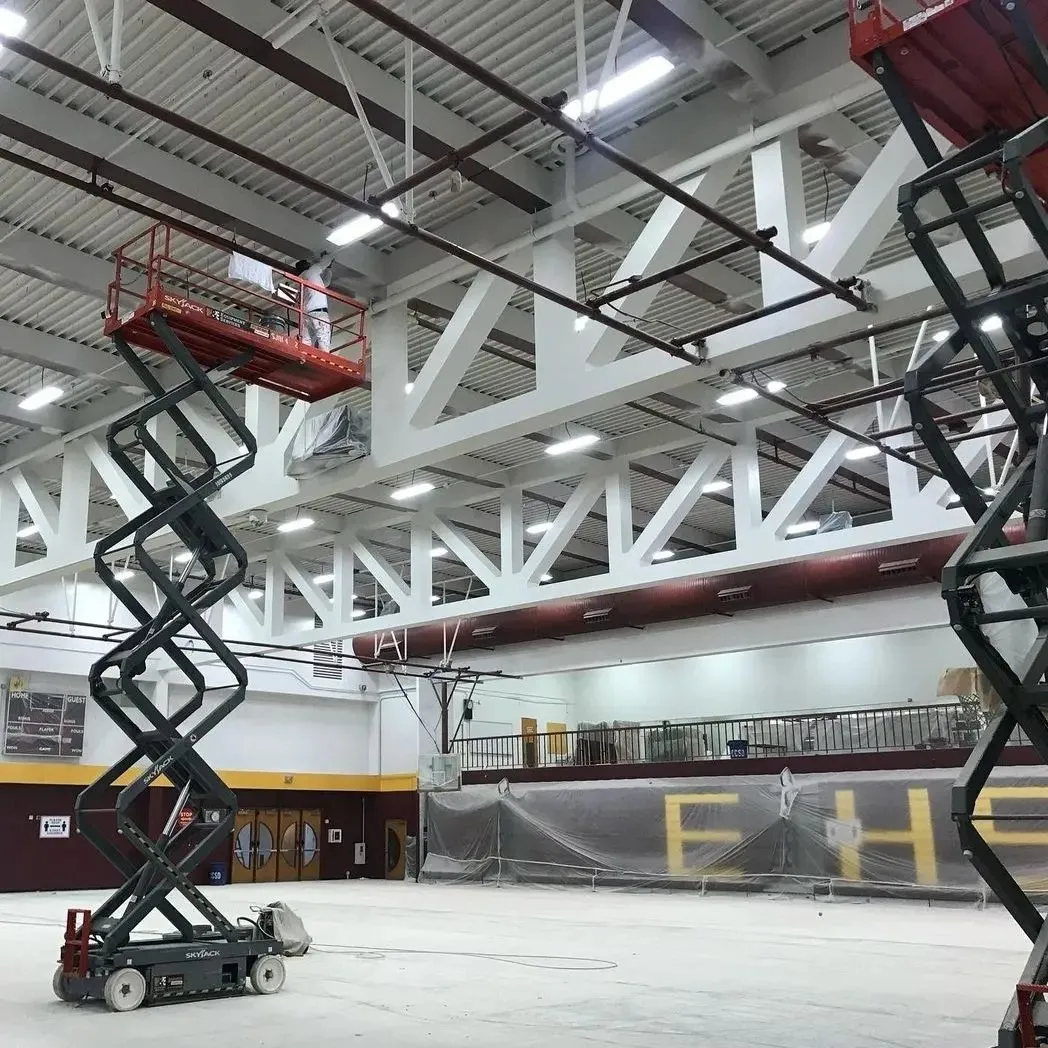
AllPro has painted school gymnasiums, a municipal aquatic center, restaurants, retail centers, office buildings and apartment communities across the Las Vegas Valley, all of them while they stayed open. We'll walk the property, propose the work window and phasing, and put the schedule in writing. We respond within two hours during business hours.
Odor, ventilation and choosing the right interior coating
Paint smell is the complaint that reaches the property manager fastest, and it's largely avoidable. Two things control it: the product and the airflow.
On product, both Sherwin-Williams and Dunn-Edwards make low-odor, low-VOC interior lines. VOCs (volatile organic compounds) are the solvents that evaporate as paint dries and cause most of the smell. Low-VOC 100% acrylic products are the standard choice for occupied interiors, and they're what we specify for offices, schools, medical suites and anywhere people return to the space within hours of painting. Ask for the product data sheet so you can share it with any tenant who asks.
On airflow, the plan should state how each zone will be ventilated. In many commercial buildings that means coordinating with whoever manages the HVAC so the work zone's air isn't recirculated to occupied floors while coatings are curing, and running fans to exhaust toward an exterior door or window where possible. Painting at the end of a shift and giving the space the night to air out is often enough on its own for low-VOC products, which is one reason after-hours interior work is so common.
Exteriors are a different story. Desert-rated 100% acrylic coatings from Sherwin-Williams and Dunn-Edwards are built to handle our UV and heat, and odor is rarely an issue outdoors. The exterior concern is cure time in heat, which is a scheduling matter rather than a product one. For a fuller breakdown of exterior coatings and prep see our Las Vegas exterior painting service page.
Tenant notice: what to send and when
Tenants don't mind painting nearly as much as they mind surprises. A simple, repeatable notice cadence prevents most complaints before they happen.
- Project announcement, two to three weeks out. What's being painted, why, the overall window, and who to contact. Keep it to one page.
- Zone notice, about one week out. Sent only to the tenants in the next phase: their dates, their work hours, what they need to move or cover, and any parking or entrance changes.
- 48-hour reminder. A short email or posted notice. This is the one that actually gets read.
- Hand-back note. Confirm the zone is finished, ask them to report anything missed, and give the date for any touch-up walk.
Include a line about odor and ventilation in the zone notice, even when you're using low-VOC products. Telling people the paint is low odor before they smell anything is far better than explaining afterward. For apartment communities, add a note on balconies, patio furniture and pets, since residents are home while the work happens.
Your painter should supply draft notices you can put on your letterhead, along with a day-by-day schedule you can forward. If they can't, that's a sign the phasing plan isn't really finished.
How long each stage really takes
Durations vary with the building, the coating and the work window, so treat these as the shape of a schedule rather than a promise. What matters is that each stage exists and has a date beside it.
- Walkthrough and scope. One site visit for most properties, longer for large or multi-building sites. This is where repairs, access and the work window are confirmed.
- Color and sample approval. Typically one to two weeks, driven almost entirely by how quickly decision makers can review samples on the wall.
- Mobilization and containment. Usually the first day in each zone. On exteriors it includes lifts, signage and parking closures.
- Prep. Washing, scraping, patching, stucco repair, caulking and priming. On exteriors this is often the longest stage and the one that most affects how the finish holds up. Skipping it to save a day costs years.
- Painting. Two coats is the standard for a durable commercial finish. Each coat needs dry time before the next, so even a small zone spans more than one shift.
- Hand-back and punch list. A walk with your point of contact, touch-ups, and removal of masking and protection.
For an interior office floor painted after hours, a realistic rhythm is several nights per zone including reset. For an exterior elevation, a working week is common, weather and repair scope permitting. Your painter should give you a per-zone estimate in writing and update it at the end of every phase.
Las Vegas weather is mostly a friend to painters, but summer heat changes exterior schedules. Crews start early, coatings are applied before surfaces get too hot, and some afternoons are lost. Monsoon season brings dust and the occasional storm. Build a little slack into exterior phases from July through September and nobody has to re-notice tenants.
What to ask a commercial painting contractor before you sign
Any contractor can say they've done occupied buildings. These questions tell you whether they've done it well.
- Can I see the phasing plan before I sign? Zones, order, days per zone and hand-back condition, in writing.
- Who is my single point of contact, and how fast do they respond? At AllPro the answer is within two hours during business hours.
- What's your containment and daily clean-up standard? Ask them to describe a normal end of shift in an occupied space.
- Which products are you specifying and why? You want named Sherwin-Williams or Dunn-Edwards lines, low-VOC for interiors, 100% acrylic for the desert exterior, and the data sheets to go with them.
- Are you licensed for the size of this job? AllPro holds Nevada commercial license #76639, rated to a $9M bid limit, and Utah license #10696814-5501. We're licensed, bonded and insured and hold a BBB A+ rating.
- What have you painted that looks like my building? Since 2008 we've completed 10,000+ projects, and our commercial work includes school gymnasiums, a municipal aquatic center, restaurants, retail centers, office buildings and apartment communities. Ask any contractor for comparable work, not just a portfolio of houses.
- How will you handle tenant notices? The right answer is draft notices and a day-by-day schedule you can forward.
If the interior portion of your project is the bigger piece, our interior painting service page covers finishes, sheens and prep for occupied spaces in more detail.
The short version for a busy manager. An occupied-building repaint goes smoothly when five things are true: the owner has chosen the work window and the priority order, the building is split into zones that are finished one at a time, each zone is contained before work starts and cleaned before it ends, the coatings are low-odor inside and desert-rated 100% acrylic outside, and tenants hear about every phase before it reaches them. None of that is complicated. It just has to be planned and written down before the first lift arrives.
If you manage a property in the Las Vegas Valley, Reno or Southern Utah and want a repaint plan built around how your building actually operates, start with our commercial painting services in Las Vegas. We'll walk the site, propose the schedule and show you what the hand-back looks like before you commit.